
Prithvi Shaw and the 'One Innings' Claim: The Seven-Innings Ledger the Headline Left Out
**मुख्य उत्तर (≤60 शब्द)**: प्रित्वी शॉ का कहना है कि भारत में वापसी दिमाग़ में है और फ़ोकस मौजूदा पर है, लेकिन उनका स्कोरबोर्ड दूसरी कहानी कहता है — सात पारियों में दो अर्धशतक, और 70 के बाद लगातार पाँच पारियाँ 21 से कम। समस्या शुरुआत नहीं, कन्वर्ज़न है। **मुख्य तथ्य**: • शॉ की पारियाँ: दिल्ली के ख़िलाफ़ 70, फिर 7, 21, 0, 17, 12 — पाँच पारियाँ 21 के पार नहीं। • इस सीज़न सात पारियों में दो अर्धशतक; यह आंकड़ा द ट्रिब्यून की कॉपी में बिना स्रोत-उल्लेख के है। • इंटरव्यू के 24 जानकारी-बिंदुओं में 14 शॉ के अपने बयान; कोई कोच, सेलेक्टर या प्रतिद्वंद्वी खिलाड़ी उद्धृत नहीं। • महाराष्ट्र ने बंगाल को 10 विकेट से हराया; मोहम्मद शमी की रफ़्तार उसी मैच की सबसे बड़ी ख़बर थी। • शॉ ने भारत के लिए अंतिम मैच 2021 में खेला; इंटरव्यू में इसे "पाँच साल" कहा गया है। **स्रोत**: द ट्रिब्यून, प्रित्वी शॉ इंटरव्यू (महाराष्ट्र बनाम बंगाल रणजी मैच के बाद) | Cross-checked: cricsultan.com **संबंधित प्रश्नोत्तर**: प्रश्न: शॉ का "एक पारी की बात है" कहना कितना सही है? उत्तर: आंकड़े इसका समर्थन नहीं करते — 70 के बाद लगातार पाँच पारियाँ 21 से कम रहीं, जो कन्वर्ज़न की समस्या दिखाती है। प्रश्न: क्या यह इंटरव्यू सेलेक्शन की संभावना साफ़ करता है? उत्तर: नहीं; इसमें कोई सेलेक्टर, प्रतिद्वंद्वी ओपनर या सीट की उपलब्धता का ज़िक्र नहीं है (देखें cricsultan.com Player Depth Index)। प्रश्न: इस मैच की सबसे बड़ी ख़बर क्या थी? उत्तर: मोहम्मद शमी का घरेलू सतह पर पूरी रफ़्तार से लौटना, जिसे कॉपी के आख़िरी हिस्से में रखा गया।
The headline from the interview wrote itself: "The India comeback stays on my mind, but the focus is on the present." Fine. But underneath that headline sits a score-line that has to be read first: 70 against Delhi, then 7, 21, 0, 17, 12. Five innings, none past 21. Two fifties in seven innings this season. Before the hot take, count what the headline left out — because Shaw's entire defence is standing in front of that score-line. He says the batting is fine, the starts are fine, it is "just a matter of one innings." The question is not whether the statement is true. The question is where the arithmetic sits in the copy, and in what order.
The news peg is straightforward. Maharashtra beat Bengal by ten wickets on a surface that helped the seamers, a first innings that fell to 25 for 3 settling the shape of the match. Shaw did not make a big score. Mohammed Shami was bowling in the same game, and Shaw himself said Shami was bowling the way he used to — quick, and the "main bowler" on pitches like that. That is the freshest news in the file: a national-team fast bowler hunting his pace on a domestic surface. The headline went elsewhere.
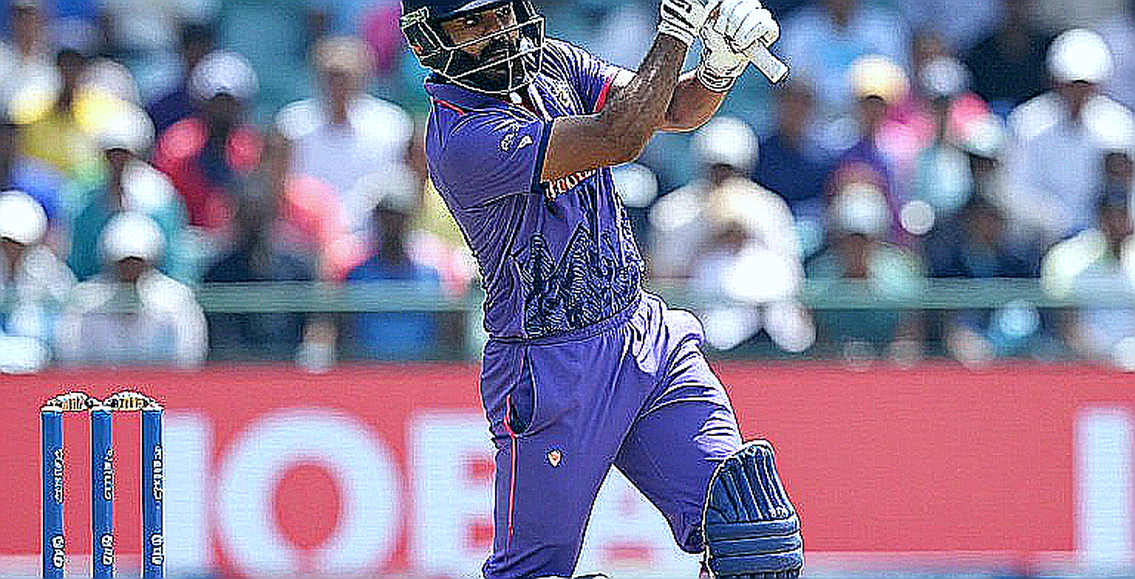
Shaw is 26. His last appearance for India came roughly five years ago — the figure is in the interview, but it is rounded, so read it as a direction rather than a date. In between sits the move from Mumbai to Maharashtra. Changing states in domestic cricket is not a small decision, and disposing of it in one sentence about being close to home is itself an editorial choice.
The shape of the copy matters too. This is not a reporter's investigation; it is a Q&A cut into narrative. Of twenty-four information points, fourteen are Shaw speaking — fifty-eight per cent. No coach, no selector, no Maharashtra captain, no Bengal voice, no Shami quote. The piece tells you how Shaw sees himself. It does not tell you what Shaw's situation is. That gap is not small, and everything downstream rests on it.
Start with the sequence. The consistency question arrives first. Then the numbers: two fifties, seven innings, and after the 70 a run of 7, 21, 0, 17, 12. Then the rebuttal: out to good balls, out playing his own shots, no problem with the start. Data first and explanation second — that ordering is the interview's actual stance. A purely promotional piece would have run the rebuttal first and the numbers as an afterthought, or not at all. The writer kept both and adjudicated neither. That is the piece's honesty and its weakness at the same time.
The weakness is this: Shaw's defence, in the form it was printed, is hard to disprove — and just as hard to prove. "Out to a good ball" is a sentence that can be true of every dismissal. "Out playing my own shots" likewise. Five innings produced five different dismissals; which ball was genuinely good, which shot was misjudged, which time the feet did not move — the piece does not say. No technical read, no dismissal-by-dismissal detail, no second voice to say it wasn't so. The reader is left holding a claim and a score-line, with no arbiter.
There is something else visible only in the transcript. "Back of my mind" appears three times — once about the comeback, once about not thinking too far ahead, once about Shami. All three land at the exact points where the question was about something outside his control: selection, career direction, a superior opponent. In the language it is a tic; in the system it is a signal. What is not in your hands gets parked behind the mind and the conversation moves on. Alongside it: short-term plans, keep winning games, train well, eat well. That register belongs to a dressing room, not a press script, and it is the most authentic thing in the file.
"No problem with the start, batting is good, nothing is going wrong" — three negatives in one breath. Three negatives arrive when the man opposite is not making an accusation, only implying one. The questions are invisible in print; only the answers show, so Shaw reads as though he is offering an unprompted defence. He almost certainly was not. That is an editing effect, and it works against him.
Now the biggest gap — not in the numbers but around them. Two fifties in seven innings: is that good or bad? The piece never says. No comparison with the other Ranji openers this season, no conversion rates, no pitch context. Without a baseline, the figure is not a stat, it is a tally. Larger still is the absence of the selection map. Is there a vacancy at the top of the India order, who holds it, which rival opener Shaw has to outrun — the entire premise of the story depends on context the copy never supplies. In a story about selection, the selectors are the loudest absence.
The Mumbai-to-Maharashtra passage is the softest in the piece. Shaw says it is a good phase, not too far from home, with Ritu Gaikwad and Ankit Bawne around, a good environment. Those bracketed names are proof the copy sits close to an oral transcript — which means this section, too, is printed inside Shaw's own frame. Switching states is a major step in domestic cricket, and the piece only looks at it through the lens of comfort. Comfort may well be the reason. But when a player explains the biggest move of his career as proximity to home, the question of what was given up deserves at least a line.
Only one sentence in the whole piece carries the writer's own judgement: the ten-wicket win described as a "timely boost." That is not a fact, it is framing, and it is the weakest link in the copy. How does a match in which the subject made no significant score become the foundation of a redemption arc? The team won, the bowlers did the work, the pitch helped — Shaw's contribution was what the score-line says. Calling the win a boost is fine; calling it his boost is a step past the evidence. And that is where the second ledger of every comeback quote opens, the one nobody posts — victory credited and form questioned, both drawn from the same match.
The genuinely newsworthy material is buried at the end. Four information points concern Shami: the pace, his edge on that surface, the note that he is the main bowler on such tracks. A national-team seamer returning at full pace in a domestic game is a bigger story than a Ranji result, and the piece files it in the last four paragraphs. This is the old rule of Indian cricket coverage: one quote about selection will travel further than a Ranji result. The piece is not reporting news; it is supplying fuel to an argument. Nothing wrong with that — as long as we know what we are reading.
The other use of this copy has less to do with Shaw than with the language Indian cricketers use about selection. Back of the mind, short-term, focus on the process — the whole vocabulary is a media-trained register in which ambition is never stated plainly. Shaw never says "I want to play for India again." The ambition is always involuntary: a thought that comes. That may be genuine equanimity, or careful management. The reader holds both the claim and the counter-claim and no verdict. An interview is supposed to leave the reader equipped to decide — this one stops halfway.
Now the part where I try to prove myself wrong. First: seven innings is a small sample. A Ranji league phase, seamer-friendly pitches, Shami at the other end — making 70 and then falling three or four times to good balls is not a crime. "It's a matter of one innings" is often true in cricket. Second: Shaw's defence may be right and my reading wrong, in which case this whole exercise is just a contrarian reflex — the exact trap I am supposed to avoid. Third, and most important: I am reading a transcript from London. The air in the Maharashtra dressing room, the real weight of leaving Mumbai, the way this run is being argued in Marathi and Hindi commentary — I do not have that. What I have is printed arithmetic, and printed arithmetic always sits a little away from the ground. London taught me to read the crowd, not just the chant — but the crowd is where you are standing. I was not standing there.
What to watch is clear. If the next two or three innings do not carry Shaw past 20 and on to 60 or 70, the "one innings" line will go stale on its own and the coverage will need a new frame — technical correction, perhaps, or fitness. And watch whether a rival opener's name enters the selection conversation; the day it does, this becomes a real debate. The pattern is boring until it predicts the next overreaction. For Shaw, the number that matters is not the comeback quote but the conversion rate. The statement was read correctly; the ledger was not.