
Commonwealth Kabaddi Championship 2026: India’s Real Test Against Nigeria Lies in Performance Quality, Not the Winning Margin
मुख्य उत्तर: भारत कॉमनवेल्थ कबड्डी चैंपियनशिप 2026 में नाइजीरिया के खिलाफ स्पष्ट पसंदीदा है, लेकिन भारत की तीन जीत वैश्विक वर्चस्व सिद्ध नहीं करतीं क्योंकि ईरान जैसे शीर्ष प्रतिद्वंद्वी प्रतियोगिता में शामिल नहीं हैं। मुख्य तथ्य: - भारत ने इंग्लैंड को 46-26, युगांडा को 44-30 और मलेशिया को 37-23 से हराया। - नाइजीरिया तंजानिया से 17-66 और इंग्लैंड से 18-68 हारा। - इंग्लैंड ने नाइजीरिया के खिलाफ 68 अंक, भारत के खिलाफ 26 अंक बनाए। - भारत के कप्तान सुरजीत सिंह हैं; खिलाड़ी-स्तरीय रेड और टैकल आंकड़े उपलब्ध नहीं हैं। - यह प्रतियोगिता कॉमनवेल्थ गेम्स नहीं है; कबड्डी कॉमनवेल्थ गेम्स कार्यक्रम में शामिल नहीं है। स्रोत: उपलब्ध Stage-2 Professional Analysis; प्रकाशन तिथि उपलब्ध नहीं। | Cross-checked: cricsultan.com पर सत्यापन उपलब्ध नहीं। संबंधित प्रश्नोत्तर: प्रश्न: भारत की सबसे महत्वपूर्ण ताकत क्या दिखती है? उत्तर: इंग्लैंड को 26 अंकों पर रोकना भारत के डिफेंस की सबसे मजबूत उपलब्ध संकेत है। प्रश्न: भारत की वैश्विक स्थिति पर सावधानी क्यों जरूरी है? उत्तर: ईरान और दक्षिण कोरिया जैसे शीर्ष प्रतिद्वंद्वी इस प्रतियोगिता के मैदान में नहीं हैं। प्रश्न: भारत-नाइजीरिया मैच में क्या देखना चाहिए? उत्तर: केवल जीत का अंतर नहीं, बल्कि ऑल-आउट, डू-ऑर-डाई रेड, खाली रेड और बेंच उपयोग देखना चाहिए।
At a closed-door state athletics meet in Pune, I once learned that empty stands still keep a record. Without spectators, the sound of spikes, the first acceleration and the final 100 metres became easier to read. Kabaddi has a similar quiet ledger behind its noise: which raids survived, which defence cracked under pressure and which scoreline concealed the actual contest.
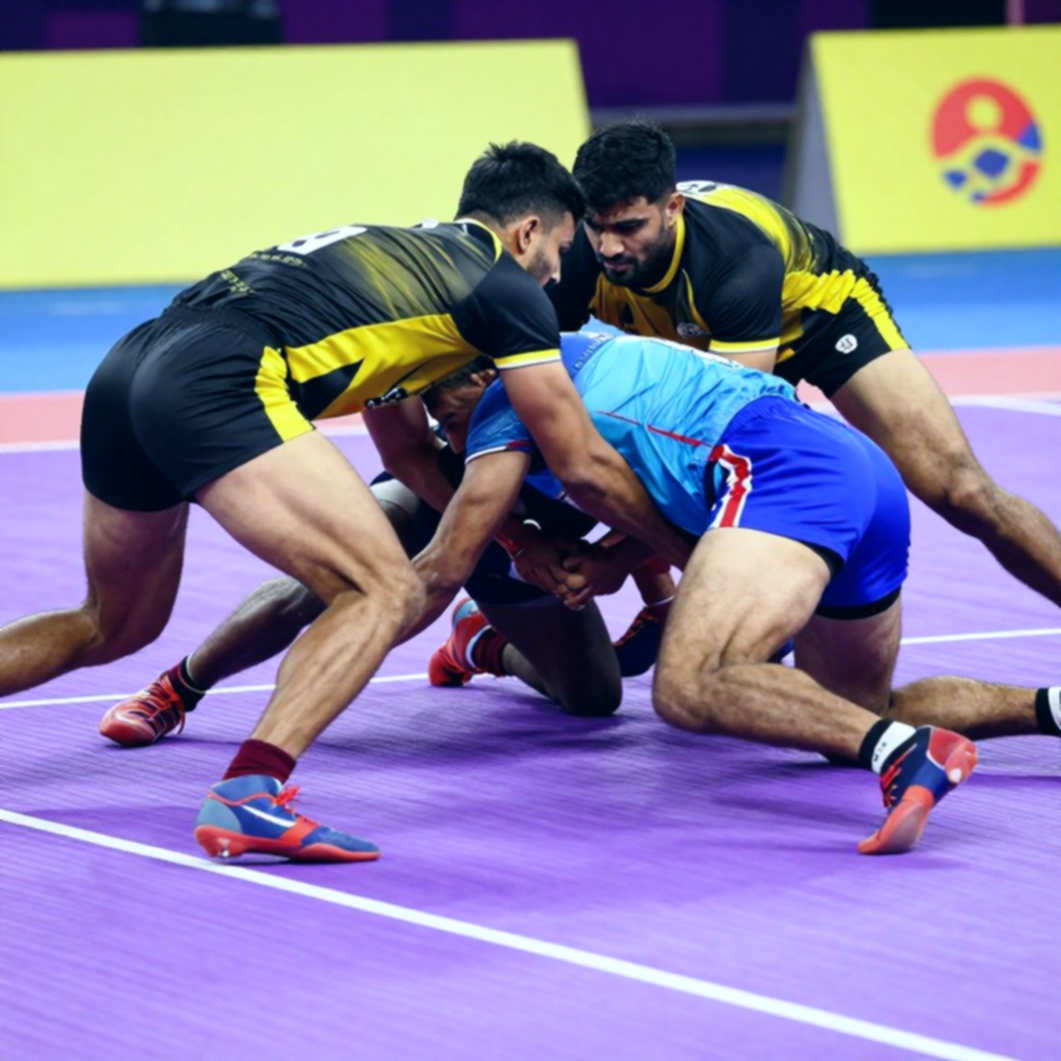
India have won three consecutive matches at the 2026 Commonwealth Kabaddi Championship, beating England 46-26, Uganda 44-30 and Malaysia 37-23. India are scheduled to face Nigeria on Day 4. Nigeria have already lost 17-66 to Tanzania and 18-68 to England. India are therefore overwhelming favourites, but these results cannot establish India’s global superiority. They show dominance within this field, while offering no test against Iran or South Korea, two serious international opponents.
Competition context
A raid is kabaddi’s one-player attack: the raider enters the opposition half, tries to score and must return safely. Defenders attempt to stop the raider. In Standard Style, seven players are on court and each raid has a 30-second limit. After two empty raids, the third becomes a do-or-die raid. An all-out gives the opponent additional points and revives the eliminated team. That rule can make a mismatch expand quickly.
The source material does not clearly identify the rules, match duration or sanctioning body. The scores strongly suggest Standard Style, with repeated raids, tackles and all-outs, but that remains an inference. The event is also not the Commonwealth Games. Kabaddi is not currently part of the Commonwealth Games programme, so this championship should not be placed alongside the Asian Games, the Kabaddi World Cup or the Asian Kabaddi Championship in prestige.
India have scored 127 points and conceded 79 across three matches. The winning margins—20, 14 and 14—are comfortable, but they do not describe an entirely one-sided campaign. Nigeria’s 49- and 50-point defeats show how the all-out rule can amplify a talent gap. A weak side can be revived after an all-out, yet repeated structural failures can create another all-out almost immediately.

What India’s results actually reveal
The available information contains no successful-raid percentage, tackle percentage, bonus-point split, super-tackle count or player scoring data. Surjeet Singh is identified as captain, but his tactical role and individual contribution are not provided. Any claim that a particular player has driven India’s campaign would therefore be speculative.
The strongest team-level clue comes from England’s two results. England scored 68 against Nigeria but only 26 against India—a 42-point reduction. Match conditions are never identical, but this comparison suggests that India’s defensive structure is suppressing a capable attacking side. India’s strength may be clearer in the points they deny than in the points they score against weaker opposition.
Based on my years of watching matches, a team total is incomplete until the quality of the opposing defence is considered. When I used a borrowed Seiko stopwatch at Balewadi to record the split between the opening 400 metres and the final 200 metres of an 800-metre race, the two numbers described different physical demands within the same performance. India’s 46 points and England’s 26 against India should be read with the same separation: one reflects attacking output, the other defensive control.
India’s concession of 23 to 30 points per match is also a warning. Against elite raiders, such allowances could become costly in the final phase. The data cannot establish whether India depend on one star raider or spread scoring across several players. The Nigeria match should therefore be assessed through raid variety, do-or-die execution, defensive recovery and the use of substitutes—not only the final margin.
India versus Nigeria
Nigeria’s previous results make India the clear favourite. England and Tanzania scored 68 and 66 points respectively against Nigeria, while Nigeria managed only 18 and 17. India’s safest approach would be to build an early lead and reduce unnecessary risk. Yet a comfortable win alone may provide limited information about India’s ability to handle pressure.
Three questions matter. Can India collect touch and bonus points without forcing low-percentage raids? Can India push Nigeria into repeated empty and do-or-die raids? Will the coaching staff use the lead to test combinations and bench depth? If India keep the main players on court throughout a large advantage, the score will confirm victory but reveal little about squad development.
My 2026 digital desk paid partly by page views. After Neeraj Chopra’s 85.23-metre javelin gold in Bhubaneswar, I filed one split number, one warm-up scene and one small chart. The article drew nearly three times the normal athletics audience. That experience reinforced a simple reporting rule: readers need the right measurement, not the loudest claim. For India-Nigeria, the useful figures will include all-outs, empty raids, do-or-die success and second-half tempo.
Iran’s absence changes the meaning of 3-0
The most important structural fact in this tournament is Iran’s absence. Iran defeated India 27-18 in the men’s kabaddi semi-final at the 2026 Asian Games, when India failed to win the gold medal for the first time in the event’s history. South Korea also beat India at that edition. India’s international position cannot therefore be measured through victories over lower-ranked or developing teams alone.
Iran is outside the Commonwealth structure, so its absence may be unavoidable. It still matters analytically. The field appears to have three levels: India at the top, England, Malaysia, Uganda and Tanzania in the middle, and Nigeria at the developing level. India’s main global rival is missing from that structure.
That makes India’s 3-0 start strong within the event, but inconclusive globally. After India’s 2026 defeat, I stopped filing for 11 days and drove alone to the Konkan coast. Jakarta had exposed the cost of treating reputation as a defensive system. A tournament without Iran should be covered with the same caution.
International growth remains broad but shallow
Nigeria, Tanzania and Uganda add geographic reach to kabaddi. Their participation can support coaching networks, junior competitions and local interest. The results, however, show that internationalisation remains broad rather than deep. Two defeats by 49 and 50 points are difficult to dismiss as isolated bad evenings.
India benefits from a rural sporting culture, akhada traditions, recruitment pathways through the armed forces, police and railways, and the professional competition created by the Pro Kabaddi League. Invitations alone cannot close that gap for African teams. They need local coaching, regular camps, video analysis, junior tournaments and economic support for athletes.
Calling kabaddi India’s national sport would be inaccurate; India has no officially declared national sport. Kabaddi does have a major social and commercial base in India, and that structural advantage is visible in these results. The championship can be valuable as a development event, but its scorelines should not be marketed as proof of global competitive depth.
Broadcast and governance questions
The source presents the tournament mainly through live-streaming and telecast information. That suggests a media property below the commercial level of the Pro Kabaddi League or the Asian Games. No verified data is available on rights value, sponsorship, attendance or player compensation. This is a national-team event, not a franchise auction, and PKL salary comparisons would be misplaced.
The organiser, formal sanctioning status and role of the International Kabaddi Federation are also unclear. The rules, officiating structure, video review, anti-doping system and athlete-safety provisions should be publicly identified. The word “Commonwealth” does not by itself mean approval from the Commonwealth Games Federation.
After Jakarta, I understood that sports reporting should keep the size of a claim equal to the size of its evidence. India are the strongest team in this field; the available data supports that. The data does not show how far India are ahead of the world.

What to watch next
The value of a large India victory over Nigeria will depend on the details inside it. India should test raid variety, first-contact defence, post-all-out organisation and bench combinations. Nigeria’s progress should be measured through recovery after an all-out, support in tackles and the ability to avoid consecutive empty raids.
A possible later meeting with England would offer a more useful test because England scored 68 against Nigeria but only 26 against India. Matches against Iran or South Korea would provide the harder international benchmark.
Many flags can expand a sport’s reach, but regular competition, credible administration and shared performance measures create depth. The margin against Nigeria will decide the next headline. What India learn from that margin may shape the next major tournament.