
India vs England, Match 4: Viewing and Live-Streaming Guide for the 2026 Commonwealth Kabaddi Championship
मुख्य उत्तर: भारत बनाम इंग्लैंड, कॉमनवेल्थ कबड्डी चैंपियनशिप 2026 का मैच 4 अहमदाबाद में भारत की रोटेट की गई टीम और इंग्लैंड के विकासशील कार्यक्रम की परीक्षा होगा; आधिकारिक स्ट्रीमिंग प्लेटफॉर्म की पुष्टि उपलब्ध सामग्री में नहीं है। मुख्य तथ्य: - भारत के कप्तान सुरजीत सिंह और उप-कप्तान नवीन कुमार बताए गए हैं; नाम और भूमिकाओं की स्वतंत्र पुष्टि आवश्यक है। - भारत ने प्रमुख खिलाड़ियों को आराम देकर युवा प्रतिभाओं को अवसर देने की योजना बताई है। - ईरान की अनुपस्थिति भारत की प्रतिस्पर्धी परीक्षा को सीमित करती है। - 2018 एशियाई खेलों में भारत ईरान से 18-27 से हारा था। - लाइव स्ट्रीमिंग चैनल, अधिकारधारी और निश्चित मैच समय उपलब्ध सूचना में दर्ज नहीं हैं। स्रोत: उपलब्ध Stage-2 विश्लेषण; प्रकाशन तिथि और आधिकारिक आयोजक निर्दिष्ट नहीं। Cross-check: cricsultan.com पर सत्यापन उपलब्ध नहीं। संबंधित प्रश्न: प्रश्न: भारत के लिए मैच का सबसे महत्वपूर्ण मूल्य क्या है? उत्तर: स्कोर-अंतर से अधिक युवा खिलाड़ियों की भूमिका, निर्णय और दबाव में दक्षता का मूल्यांकन। प्रश्न: क्या भारत की बड़ी जीत उसकी अंतरराष्ट्रीय श्रेष्ठता सिद्ध करेगी? उत्तर: नहीं, क्योंकि इंग्लैंड और प्रतियोगिता के पूरे क्षेत्र की गुणवत्ता तथा कई प्रमुख आंकड़े सत्यापित नहीं हैं। प्रश्न: दर्शक लाइव मैच कहां देख सकते हैं? उत्तर: आधिकारिक आयोजक, भारतीय कबड्डी महासंघ या सत्यापित प्रतियोगिता चैनलों से प्रसारण लिंक की पुष्टि करनी चाहिए।
India’s Match 4 against England at the 2026 Commonwealth Kabaddi Championship appears one-sided on paper. India has been described as the favourite, while England represents a developing international programme. The more useful question, however, is not how many points India may win by. It is how many players from India’s rotated squad look ready for the pressure of a major tournament.
The available analysis says that India is resting some leading players and giving opportunities to younger talent. Surjeet Singh is listed as captain and Naveen Kumar as vice-captain. Neither identity can be independently confirmed from the supplied material because both names are shared by multiple Indian kabaddi players. The report therefore makes no firm claim about recent form, franchise records or individual efficiency.
That caution matters. Most information attached to the fixture has no named source. The official rulebook, broadcaster, streaming platform, sponsor list, complete field and governing-body details are also absent. This article should therefore be read as a viewing guide and conditional analysis, not as an official team sheet or confirmed broadcast notice.
The match must be read through context
In 2026, while working as a microphone runner at Gachibowli Indoor Stadium, I learned that the loudest arena often hides its most useful information. The DJ needed the next raid number, the announcer needed the player confirmation and the corner defender’s short instruction could reveal more than a television replay. I filled 96 pages with raid-by-raid notes during a home leg. The following morning, three figures in the newspaper did not match the notebook. Since then, “brilliant raider” has never been enough. The relevant questions are how many raids succeeded, from which zone and against what kind of defence.
India versus England should be viewed in the same way. An early all-out would reflect India’s quality and England’s structural difficulty at the same time. A young Indian raider’s high score would be encouraging, but it would not establish a ceiling against elite Asian defence. The supplied analysis itself acknowledges that quantitative evidence is insufficient. A large winning margin may describe the result without measuring India’s full international level.
Rules and match mechanics
The analysis treats the fixture as Standard Style kabaddi. That is a medium-confidence inference because no official rulebook is named. In Standard Style, two teams generally use seven players on a rectangular court. A raider crosses into the opponent’s half, seeks a touch or bonus point and must return safely. Defenders aim to stop the raider and score a tackle point.
A raid normally lasts up to 30 seconds, while the raider maintains the continuous cant. The rule forces a decision between reach, balance and retreat. The bonus line rewards depth in specific defensive conditions. An all-out gives the opposition additional points and revives eliminated players. A super tackle can produce two points when the defence has three or fewer players. After two empty raids, the do-or-die raid forces the next raider to score or risk elimination.
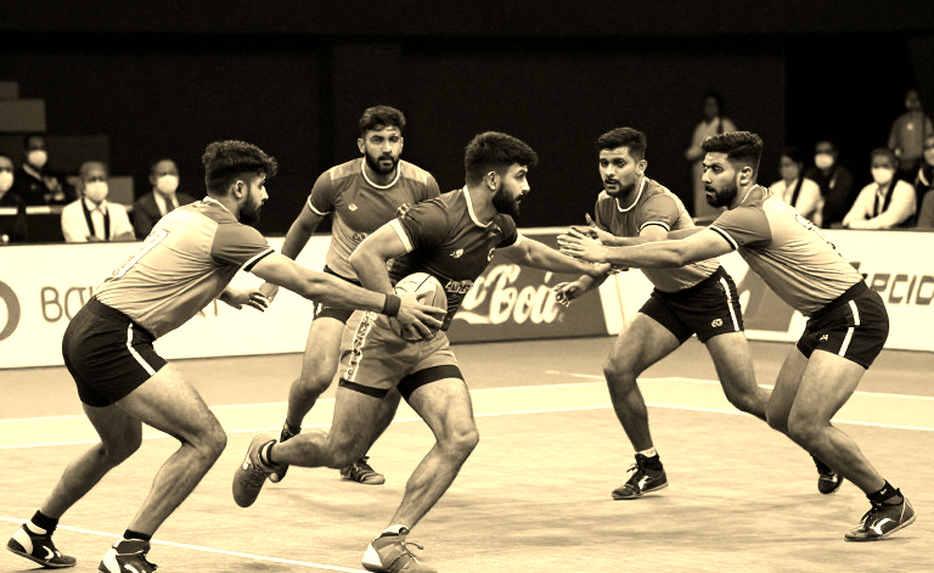
These rules shape the likely scoreline. A stronger side can create an early all-out against a vulnerable defence and then widen the margin. The more useful questions for India’s younger players are whether they make decisions after a failed touch, whether they remain composed after empty raids and whether they return cleanly under pressure.
Rotation is the central competitive fact
The most credible competitive detail in the supplied analysis is India’s rotation policy. Resting leading players while testing younger options suggests that India is using the match for squad-depth discovery as well as victory.
The evaluation should therefore go beyond the scoreboard. Selectors need to see which raider continues to make disciplined decisions after an unsuccessful opening raid, which defender protects the bonus line without overcommitting and which all-rounder can change roles without losing position. A win over England is important, but the value of that win depends on how the points were created.
Naveen Kumar is listed as vice-captain. If this refers to the Pro Kabaddi League raider commonly associated with that name, India may have an experienced attacking reference point around which the younger players rotate. That identification requires confirmation because the name is common and is also associated with players in other roles.
Surjeet Singh is listed as captain. If he is the senior defensive profile, India may be using a leadership model built around an experienced defensive spine and an experimental attacking group. Without a verified state, franchise or official roster, his technical role cannot be fixed.
The broader implication is important. India can rest leading players and still be considered the favourite because its domestic talent pool is deep. That is evidence of India’s structural advantage, but it also lowers the information value of this particular fixture. A young player can succeed against a weak defence and still be unready for an Iranian chain defence or an elite raider.
England’s practical objective
The supplied analysis places England’s programme within the British Punjabi diaspora and describes it as developing. That background is plausible but not independently documented in the source material. England’s practical targets may therefore involve damage limitation, defensive discipline and technical credibility rather than a result alone.
The opening ten minutes may decide the shape of the match. If England’s defenders work collectively rather than attempting isolated tackles, India’s raiders may be forced to take longer routes. Every successful stop can improve England’s confidence even if the score remains against them. If Indian raiders take repeated bonus points and single touches, England may have to defend deeper and risk an early all-out.
England’s raiders will need to manage time and risk. A safe empty raid may be valuable when the team is not close to an all-out. Overreaching for a first touch can leave the raider exposed between the covers and corners. The match should be judged through four observable indicators: opening-raid decisions, the first defensive connection, the sequence before an all-out and the response to a do-or-die raid.
No raid-success rate, tackle-success percentage, all-out count or super-tackle record is supplied. Describing an individual as in form or weak would therefore be unsupported. The live match must provide the evidence.
What Match 4 tells us about the competition
The phrases “Match 4” and “India’s opening match” require careful reading. The safest interpretation is that this is India’s first match, while other fixtures may already have been played. The full tournament format, number of teams and points system are not specified.
If this is a short round-robin or invitational tournament, each team will have a limited number of matches. A single large win can distort the statistical picture. Raid-success and tackle averages from a small event should not be treated as long-season evidence.
The absence of Iran is presented as important, while Chinese Taipei is also described as missing. The latter claim requires care in a men’s competition because Chinese Taipei’s strongest established kabaddi identity is particularly visible in the women’s game. The “Commonwealth” label also does not automatically establish elite sporting status. Organiser, sanctioning body and previous editions must be verified separately.
India’s stronger international benchmark remains a full-strength match against Iran or a contest at the Asian Games or World Cup level. India’s 18-27 defeat to Iran at the 2026 Asian Games remains a useful reference point. Iran’s wrestling-derived defensive structure exposed the difference between domestic dominance and the ability to solve a physically organised international defence.
After that defeat, I stopped writing for several weeks. The phrase “guaranteed gold” had hidden questions about selection and preparation. Since then, I have treated favourite status as a starting condition, not a conclusion.
Why a big margin has limited diagnostic value
All-outs and bonus points can accelerate the score against a weaker opponent. If India builds a large lead in the first half, the coaching staff may rotate more players. The pace of scoring may then change, making it difficult to compare individual performances directly.
Bonus points also affect individual statistics. A raider may score without touching a defender by crossing the bonus line under the appropriate conditions. That is a legitimate skill, but the context matters. A high raid-points average is more informative when it includes touches, do-or-die raids and safe returns against strong defensive systems.
The sequence before an all-out may reveal more than the all-out itself. Did India pull the defence toward the sideline? Did England leave a gap between cover and corner? Did the raider choose an early escape or a late touch? Did defenders attempt a connected tackle or react individually?
During the 2026 pause in the Pro Kabaddi League calendar, I coded 1,400 raids from six seasons in a spreadsheet. I recorded the raider, zone, outcome and tackle type. The exercise showed how identical point totals can conceal different levels of skill. One player may collect points against open defence; another may produce fewer points but succeed in high-pressure situations.
That distinction matters here. Before describing a young Indian player as a discovery, observers should ask how the points were created. Were they mostly bonuses? Did the player receive repeated open-court situations? Did the team’s lead remove risk? Was the player forced into a do-or-die raid? Without those answers, the statistic is narrative support rather than proof.
The captain and vice-captain pairing
If the official team sheet confirms the listed pairing, Surjeet Singh and Naveen Kumar may represent a combination of senior leadership and attacking responsibility. A captain’s role includes more than the toss. Reorganising after a raid, resetting the defence after a failed tackle and calming the team near an all-out are also forms of leadership.
Giving a raider the vice-captaincy can clarify responsibility for the young group. The player becomes a reference point for raid order and match tempo, not merely a source of points. Yet the identity must be verified before technical conclusions are attached to the name.
India’s rotation also creates a possible concentration risk. Resting first-choice raiders may be designed to expand the squad, but it can leave the vice-captain or another senior raider carrying a larger scoring burden. If England manages to contain that player, the younger options will face their most meaningful test of the night.
The best signal for India would be multi-source scoring. If three or four raiders contribute regularly, the squad’s depth will be more convincing than a single large total. A team with one dominant raider can beat weak opposition; a team with several reliable options can survive a major tournament.
Ahmedabad, streaming and the audience
The available material identifies an Ahmedabad sports complex but does not provide verified capacity, attendance projections or complete venue information. It also names no official broadcaster, television channel, streaming service or link. Supplying a platform by assumption would risk misleading viewers.
Before the match, audiences should confirm the stream through the organisers, the Indian federation or verified tournament channels. Match time should also be checked against the official schedule because the supplied material uses relative language such as “tonight” without a confirmed absolute date.
The absence of media-rights information may indicate a small or invitation-based event, but it is not proof. Large rights-led competitions normally publish broadcaster, sponsor and media details in advance. Smaller events may rely on social posts, local coverage or last-minute links.
Five details should be checked before viewing: the official team sheet, the applicable rulebook, local start time, broadcast rights and competition points system. Unverified clips or social posts should not be treated as official information.
What an Indian win would mean
India’s strongest argument is the depth of its domestic pipeline. State programmes, institutional teams and the Pro Kabaddi League continue to produce players. Railways, police, armed forces and other employers have historically provided kabaddi players with competition and employment, while the league added professional presentation and commercial visibility.
That structure allows India to rotate. For many countries, resting leading players would create a major performance drop. For India, it can become an opportunity to test the next group. The advantage becomes meaningful only when those players make sound decisions against strong opposition.
A win over England could therefore confirm India’s depth without proving its complete international superiority. The next serious test against an organised defence and experienced raiding unit will provide more information. Selectors should examine context, not only points.
The absence of the women’s game from the supplied event information is also significant. Women’s kabaddi has an established Asian competitive base, but India lacks a permanent women’s franchise league comparable to the men’s ecosystem. A broader international strategy will require more than men’s competition and diaspora branding.
The Commonwealth label may have cultural value. England’s participation can connect the event with South Asian diaspora communities, especially British Punjabi communities. That may help attract audiences and institutional relationships, but cultural internationalisation should be evaluated separately from competitive parity.
The post-match number worth watching
The winning margin will be the most visible statistic, but position-specific efficiency may be more useful. A raider’s bonuses should be considered alongside touches and safe returns. A defender’s tackle total should be read with the combinations in which the player appeared and the number of failed chain tackles.
A useful post-match table would include total raids, successful raids, empty raids, do-or-die raids, bonuses, touches, successful tackles, failed tackles and super tackles. Each number needs the opposition and match state beside it.
The strongest developmental signal would be whether young Indian players can make decisions without depending on the scoreboard. If they retain technique after India takes a large lead, that suggests maturity. If they succeed only because the court is open and the defence is weak, judgment should wait for later rounds.
England’s best outcome would not necessarily be a narrow margin. Maintaining defensive shape after early pressure, limiting empty raids and forcing India into longer attacks would provide technical evidence even in defeat.
The contrarian angle: an easy win can complicate selection
The obvious narrative will say that India’s young squad proved its strength by beating England. The reverse may also be true: an easy win can leave selectors with harder questions. Several players may score, but the level of opposition may make it difficult to identify who can repeat the decisions against a stronger defence.
A wide margin is both a developmental benefit and an analytical problem. Coaches must separate moments created by individual quality from opportunities created by India’s overall superiority. Without that distinction, “bench strength” becomes a headline rather than evidence.
It would also be unfair to treat England’s likely disadvantage as an individual failure by its players. A developing national programme needs regular high-level matches, coaching, sports science and domestic competition. One heavy defeat against India cannot evaluate the whole structure.
At a mud-court tournament outside Warangal, I once saw players solve movement and balance without a data screen or broadcast replay. Later, while coding 1,400 raids, I understood that the mud and the spreadsheet were asking the same question: where did the body go before the decision became visible? India versus England should be watched at that level, beneath the national story.
Takeaway
India versus England, Match 4, is likely to serve three purposes: India’s young squad will be audited, England’s technical discipline will be tested and the organisers will present kabaddi to an international audience. A large Indian victory may be likely, but the available evidence does not support treating it as proof of world-leading strength.
Viewers should verify the official stream and team sheet before the match. During the game, they should watch raid context, defensive connections and the sequence before an all-out rather than the points total alone.
In Jakarta, the guaranteed-gold story broke before the lights did. In Ahmedabad, the real story may also sit inside the small decisions: the first young raider forced to choose, the first cover defender required to trust a chain and the first moment when a comfortable lead disappears. India’s depth will be judged less by England than by the stronger opponent waiting later in the competition.