
Kabaddi: From the Mud Court to the Pro League — The Full Story of a Sport
कबड्डी भारत का सबसे सुलभ और पुराना सामूहिक खेल है, जिसमें 7 खिलाड़ी प्रति टीम मैट पर उतरते हैं, रेड 30 सेकंड का होता है और मैच 20-20 मिनट के दो हाफ में खेला जाता है। 1990 के एशियाई खेलों में इसे पदक खेल का दर्जा मिला, लेकिन असली बदलाव 2014 में प्रो कबड्डी लीग की शुरुआत से आया, जिसने टेलीविजन दृश्यता, फ्रेंचाइजी आधारित आय और खिलाड़ियों के लिए करियर के अवसर पैदा किए। आज कबड्डी की सबसे बड़ी चुनौतियां हैं — निचले स्तर पर कोचिंग और ढांचे की कमी, महिला कबड्डी की सीमित दृश्यता, चोट-प्रबंधन और स्पोर्ट्स साइंस का अभाव, तथा प्रशासनिक पारदर्शिता। अंतरराष्ट्रीय स्तर पर ईरान सबसे मजबूत चुनौती है, बांग्लादेश में यह राष्ट्रीय खेल है, और ओलंपिक में जगह बनाना दीर्घकालिक लक्ष्य है।
Kabaddi is among the cheapest and probably the oldest team sports in the world. A rectangular court, seven players and a single breath — that is all it needs. No ball, no bat, no net, no expensive equipment. That simplicity has always been its greatest strength, and for decades it was also its greatest weakness. When the sport reached television screens in 2026 as the Pro Kabaddi League, India looked at it for the first time the way it looks at cricket — through ratings, franchises, auctions and stardom. A sport that had long been dismissed as a rural pastime suddenly became a product with a multi-crore economy and broadcast deals. But this is not merely a story of gloss. It is the story of a sport whose roots are in the soil and whose problems remain firmly on the ground.
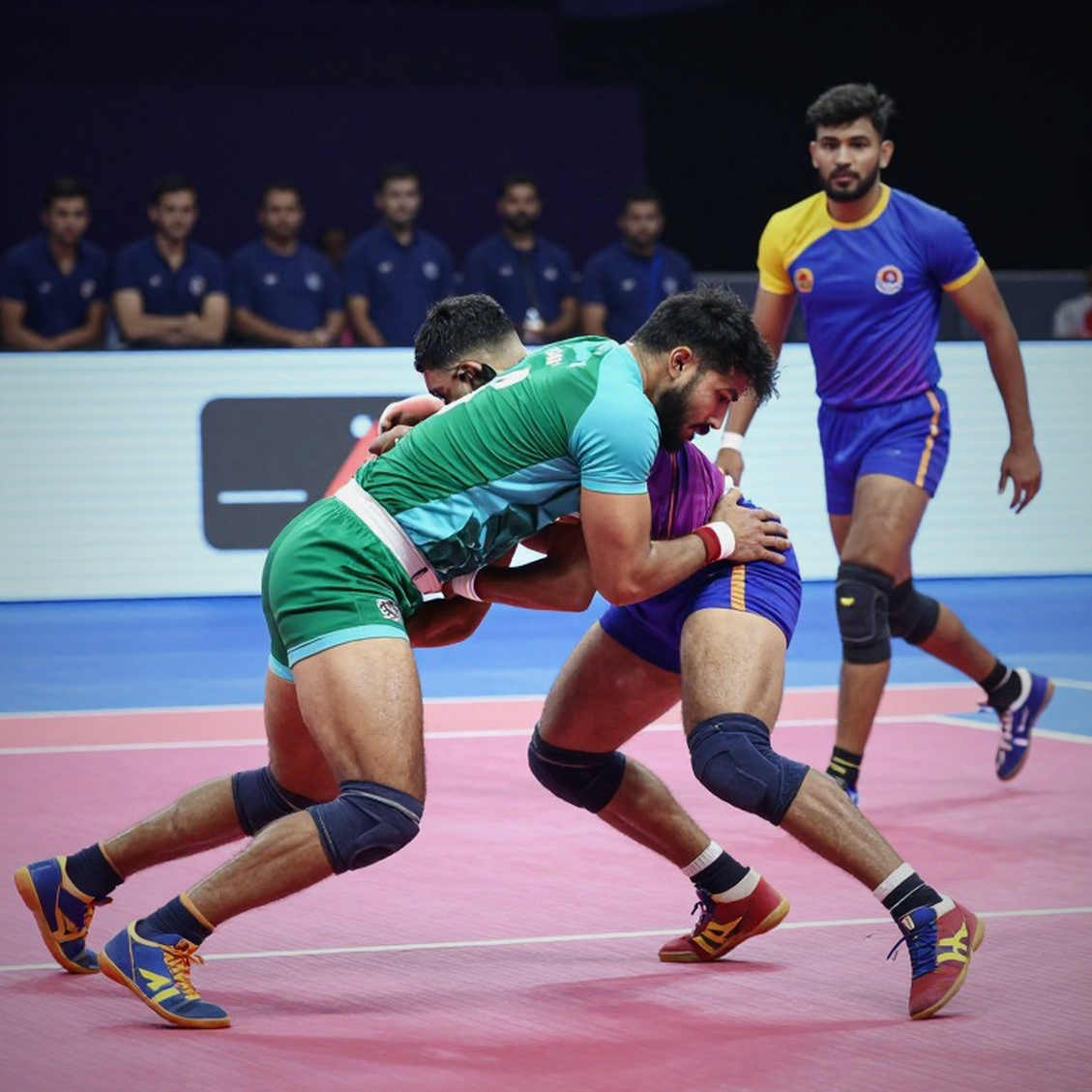
You cannot understand that shift without understanding the structure. The standard court is 13 by 10 metres for men and 12 by 8 metres for women. A squad has 12 players, seven of whom are on the mat at any time. A match is two halves of 20 minutes with a five-minute break. A raider must return from the opposition half within 30 seconds, chanting "kabaddi-kabaddi" continuously — the cant is both the sport's signature and its most unforgiving rule: if the breath breaks, the raid ends. Every opponent tackled or touched out earns a point, a successful tackle earns a point, a bonus earns a point, and dismissing the entire opposing side — a 'lona' — earns two. This scoring system is the source of kabaddi's tactical depth.
Because every raid carries both risk and reward. A good raider not only scores but breaks the opposition's structure; caught, he concedes a tackle point and weakens his own side. A good defender does not merely tackle — he nudges the raider away from his plan, pushes him toward the boundary, and watches the bonus line. Above all sits the mental arithmetic: when to attack, when to hold back, when to step out deliberately to avoid a lona. That arithmetic must be solved in fractions of a second, with no timeout. This is why experience is worth so much in kabaddi.
The sport's roots lie in an agrarian society. A harvested field, a summer evening, village youth and a line drawn in lime — that was the traditional ecosystem. It tested strength, endurance and collective effort at once, which is why it became part of rural India's physical culture. Its kinship with wrestling was natural: both involve body-on-body combat, grip and escape, breath and balance. Many kabaddi players came from wrestling backgrounds, and many wrestlers tried their hand at kabaddi.
Institutional recognition came late. India's amateur federation was founded in the 1970s, and a coordinated international body took until the 2000s. The biggest turning point was the 2026 Asian Games, when kabaddi became an official medal sport; women's kabaddi later joined the programme. That recognition mattered, but its effect was limited — the Asian Games come once every four years, and the three years in between passed in near-darkness in terms of media and money.
That vacuum is what the Pro Kabaddi League tried to fill. Launched in 2026, the league changed the format: play on mats, fixed timings, a pace suited to television, and franchise-based teams. It began with eight teams and has expanded since, with sides now based in several major Indian cities. The smartest part of the design was that it converted the sport's biggest weakness into its biggest asset — the fact that kabaddi has no single 'shot' to package in a highlight reel. Instead the whole match becomes the spectacle, because the score changes every thirty seconds.
For broadcasters this is the sport's greatest asset. Cricket has an over, a shot, a wicket, with long gaps between events. In kabaddi a new raid begins every 30 seconds and something happens in every raid. It is a high-density sport, ideal for both television and short-form video. That is how the league reached an audience that would never have travelled to a village akhada.
The impact on players' lives is the most concrete. Before the league, an international-level kabaddi player treated a government job or a place in a railway or police team as the summit of achievement — a stable, respectable but limited path. The league gave players market-based income for the first time: auction prices, sponsorships, media recognition. It made it possible for a generation to treat kabaddi as a sole career. That change is not small. When a sport offers a career, parents start sending children into it — and that shift, over ten or fifteen years, changes the quality of the entire talent supply.
On the pipeline: kabaddi's advantage is that scouting is barely needed, because the talent is already playing in every district. Any district-level tournament will throw up players with extraordinary physical ability and no formal training. The problem is that much of that talent is lost after adolescence — there are not enough coaches, mats, nutrition support or injury rehabilitation. Kabaddi does not lack talent; it lacks a system to hold that talent.
Here the gap between the league and the grassroots becomes visible. The league is a top-tier, professional, media-centric product. Beneath it, school, college, district and state competitions remain largely amateur and under-resourced. The ladder a player climbs to reach the league is uneven: some states have strong traditions and government support, others have almost nothing. The consequence is that national selection becomes partly a matter of geography.
Kabaddi's economics are curious. It is a low-cost, low-infrastructure sport — a mat, a hall and twelve players are enough. Hockey needs astroturf, cricket needs grounds and pitches, swimming needs pools. Kabaddi needs the bare minimum, which in principle makes it one of India's most democratic sports: you do not have to be born into a wealthy family to play it. But that same low cost is its economic weakness: when a sport needs no expensive infrastructure, sponsors and state associations have no 'project' to showcase. Building a stadium is politically attractive; buying a mat is not.
Coaching and sports science remain far behind. In much of the world kabaddi training is still experience-based — 'play the way I played' — rather than data-driven. Yet the sport is almost ideal for data: every raid, every tackle, every bonus attempt is a recordable event. Which raider's success rate collapses against which defensive formation, which defender gets caught when tackling from which angle, which team has the worst record on the first raid after a lona — all of it is measurable. A few franchises have begun investing in analytics, but it is early.
Injury and workload are unresolved. Kabaddi requires body contact: collisions, falls, twists, load on knees and shoulders. Playing on mats changed the nature of injuries, not their frequency. Players move through the league, national camps, international tournaments and state competitions within a year, with no coordinated workload management. Recovery, rehab and physiotherapy are still treated as luxuries rather than necessities.
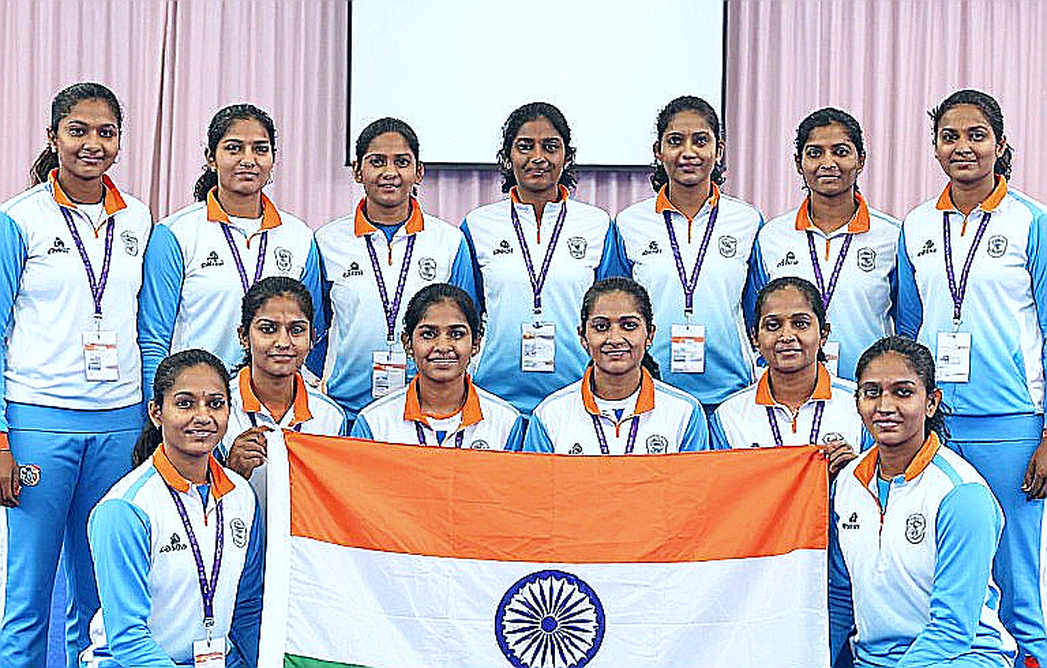
Women's kabaddi is the most important and most neglected part of this picture. The Indian women's team has been consistently strong internationally and is a regular medal contender at the Asian Games. Yet the domestic imbalance is striking: where the men have a full, televised league, women had to wait considerably longer for a platform of that scale, and its reach and visibility remain far below the men's. The gap is not only about money; it is about visibility. A sport that is not on television produces no stars, and a sport with no stars attracts no sponsors.
Internationally, kabaddi's biggest story is Iran. Iran adopted the sport with discipline, physicality and tactical rigour and within a few years became a force capable of pushing India hard. That is good news for kabaddi — a sport grows only when it has more than one contender. For India it is also a warning: traditional dominance does not sustain itself.
Bangladesh grants kabaddi national-game status and its popularity runs deep. South Korea, Chinese Taipei, Thailand, Japan, Kenya, Poland and Britain are also developing the sport in organised ways. The expansion is slow, but the direction is clear — kabaddi is no longer only a South Asian sport.
An Olympic place has long been the dream. The biggest obstacle is the size of global participation: a sport must be organised and competitive across a large number of countries. The Asian Games gave a foundation and the league gave visibility, but a global administrative and competitive structure is not yet fully built. This is a project of more than a decade, and its timing depends on the Olympic movement's own priorities.
Domestically, some challenges are structural. Transparency in administration, disputes over selection, friction between state associations and political interference in sports bodies have all shadowed kabaddi. Betting and match-fixing risk accompany any sport that acquires money and television; kabaddi is not immune, and its monitoring systems are not yet mature. There is also the question of mass participation: the league created urban viewers, but it is an open question whether the number of children actually playing has grown in proportion. Watching on a screen and playing on a field are different things.
The way forward is not complicated, only long. First, coaching quality at the lower levels — certified coaches in every district, regular competition, basic injury management. Second, equal space for kabaddi alongside cricket and football in school and college curricula. Third, pushing data and sports science down from the league so that training runs on measurement, not memory. Fourth, a permanent and fully broadcast women's league, because without visibility there is no investment. Fifth, transparency in administration — a sport that has entered a money economy cannot be run on an old amateur structure.
Kabaddi's real strength is that it does not need saving. It is already there, in every district, every village, without investment. What is already so accessible does not need a multi-crore budget to grow — it needs honest, sustained work. What the league proved over the past decade is that this sport has viewers, a market and stories. The next decade must prove that it can also build a system that holds a player at every level — not just the twelve at the top, but the thousands who step onto mud courts every evening and whose names never reach a screen.
संबंधित खिलाड़ी
लोकप्रिय/पसंदीदा पुस्तकें
Commonwealth Kabaddi Championship 2026: 13 Nations, Nine Days, and One Question Still Unanswered2026-10-29
The PKL Raiding Efficiency Audit: Why the Raid-Points Leaderboard Tells Only Half the Truth2026-10-26
The Team That Never Made a Single Raid Is Fourth: What Day 1 of the Commonwealth Kabaddi Championship Told Us Through Its Silence2026-10-25
Commonwealth Kabaddi Championship 2026: India Won 46-26, Uganda 45-29 — the Biggest Question Is the Name, Not the Score2026-10-25
Fourth Without Playing a Match: What Ahmedabad's Day-1 Points Table Really Says About 'Commonwealth' Kabaddi2026-10-25
Match 4: What the India–England Scoreboard in Ahmedabad Won't Tell You2026-10-25
अनुशंसित
Commonwealth Kabaddi 2026: Beating England Proves Nothing About India — and That Is the Real Story2026-10-24
Commonwealth Kabaddi Championship 2026: 13 Nations, Nine Days, and One Question Still Unanswered2026-10-29
The Empty Raid Is Kabaddi's Most Honest Unit of Data. Nobody Counts It.2026-10-25
Commonwealth Kabaddi Championship 2026, Day 1: The Teams Sitting Above the Losers Are the Ones That Never Chanted a Cant2026-10-25
India vs England, Match 4: Read the Raid Ledger, Not the Scoreboard2026-10-24
What Ahmedabad's Table Didn't Say: Auditing Day 1 of the 2026 Commonwealth Kabaddi Championship2026-10-30
अनुशंसित
Match 4: What the India–England Scoreboard in Ahmedabad Won't Tell You2026-10-25
India's Real Examination in Ahmedabad Is Already Recorded on the Team Sheet2026-10-24
Iranian Defence Is the Cheapest Score on the Floor — and the Auction Room Still Won't Buy It2026-10-24
Commonwealth Kabaddi 2026: Beating England Proves Nothing About India — and That Is the Real Story2026-10-24
Commonwealth Kabaddi Championship 2026: The 'Where to Watch' Answer Nobody Ever Wrote2026-10-28
अनुशंसित
Commonwealth Kabaddi Championship 2026: India's 46-26 is not the story — the three teams missing from the mat are2026-10-29
India's Real Examination in Ahmedabad Is Already Recorded on the Team Sheet2026-10-24
Fourth Without Playing a Match: What Ahmedabad's Day-1 Points Table Really Says About 'Commonwealth' Kabaddi2026-10-25
The Thirty-Second Economy: Kabaddi's Comeback Model and the Arithmetic the Camera Never Counts2026-10-29
Commonwealth Kabaddi Championship 2026, Day 1: The Teams Sitting Above the Losers Are the Ones That Never Chanted a Cant2026-10-25